Field Investigations Practicals
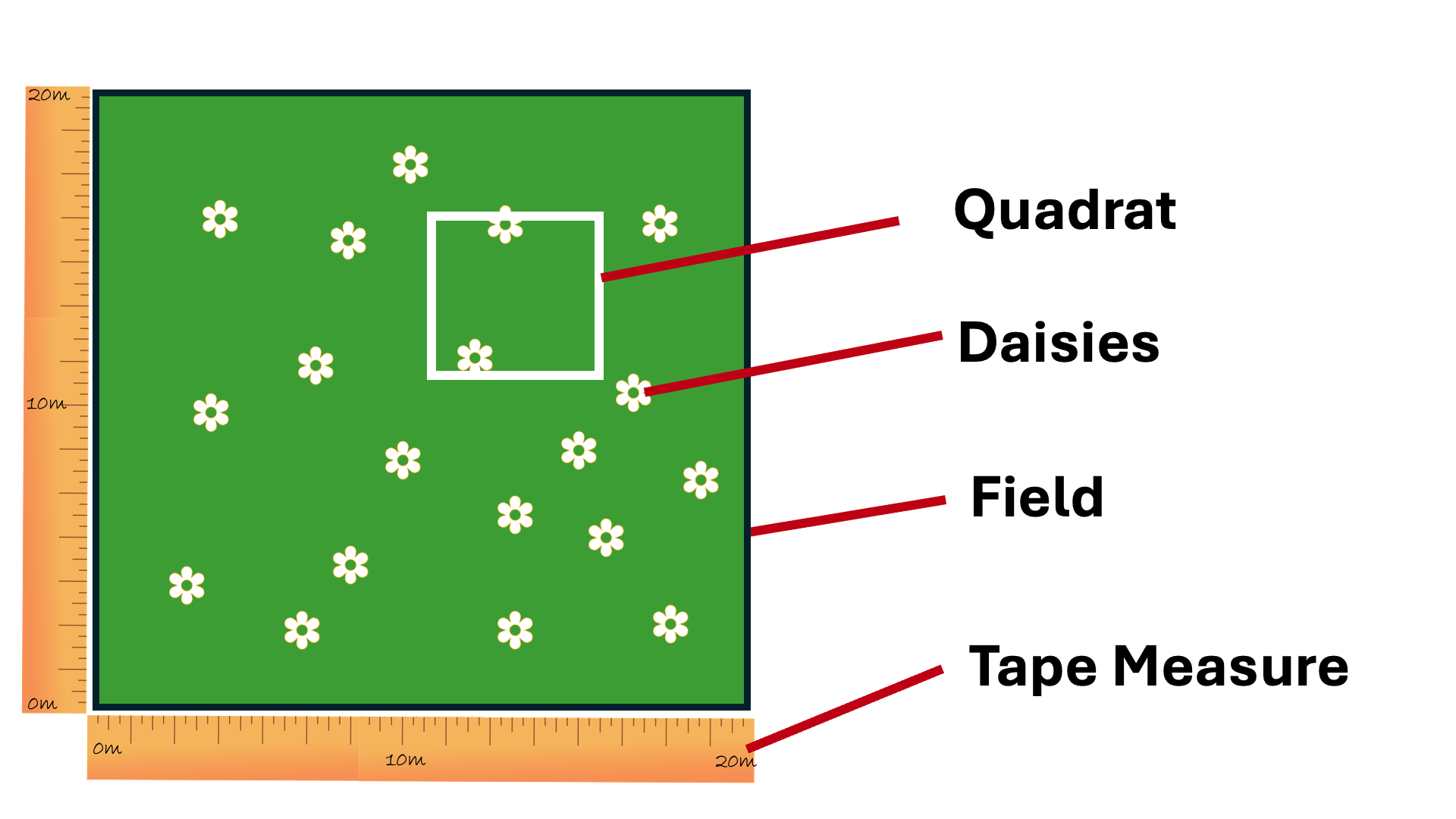
Investigation 1. Population size
- Using two tape measures, create a 20m x 20m square in a field.
- Use a random number generator to obtain two random numbers between 0 and 20. Use the numbers as coordinatesa long the tape measures.
- Set down a quadrat at the coordinates.
- Count and record the number of Daisies inside the quadrat.
- Repeat steps 2 - 4 nine more times to have a total of ten measurements.
- Add up the number of Daisies recorded inside all ten quadrats.
- Estimate the total number of Daisies in the 20x20m field using the equation:
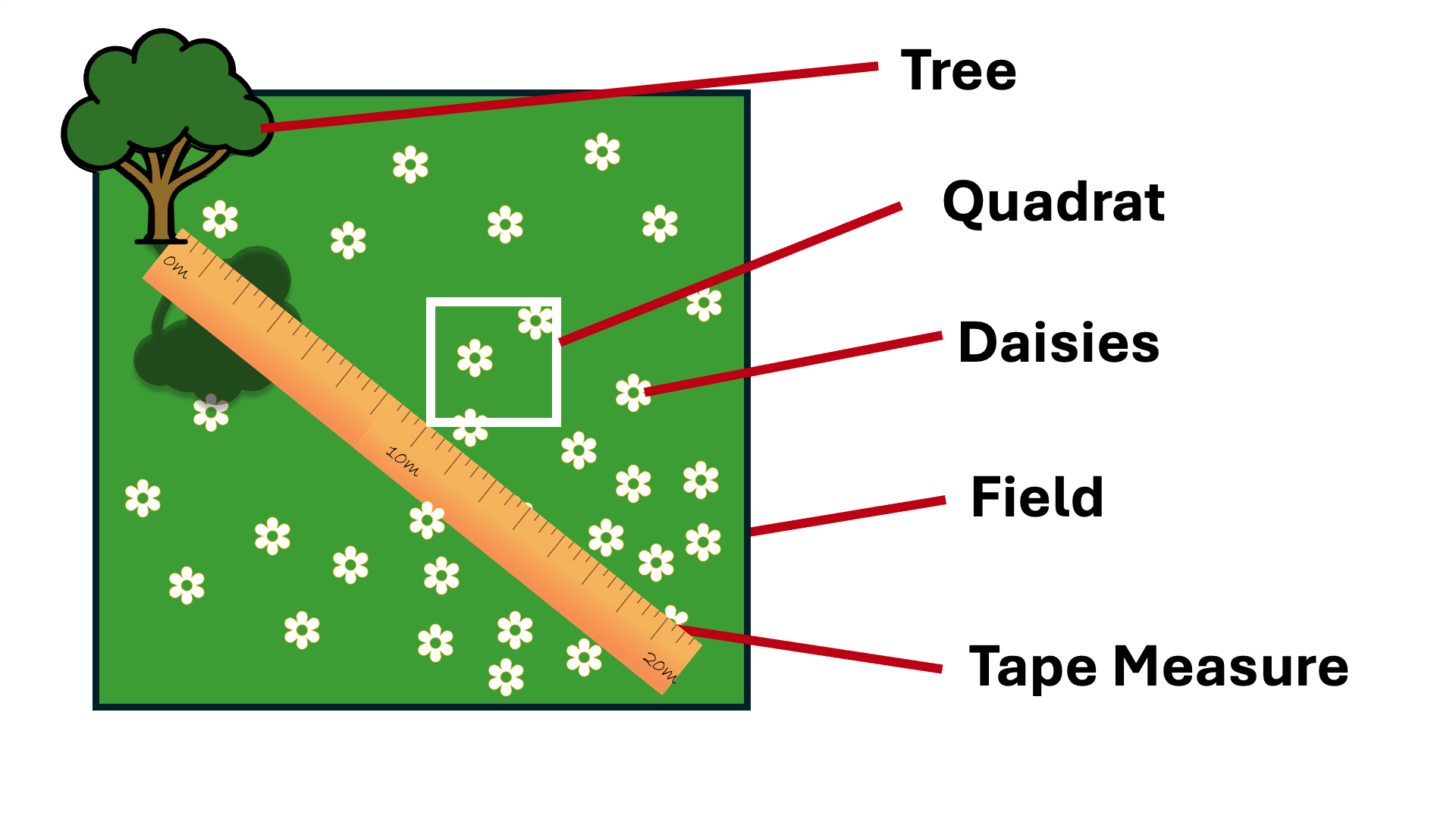
Investigation 2. Effect of variation in a factor
- Lay a tape measure from the base of a tree to an open area of ground.
- Place a quadrat touching the 0m mark on the tape measure.
- Count and record the number of daisies in the quadrat.
- Repeat step 3, placing a quadrat at 5m intervals along the tape measure until the end of the transect line.
- Plot a graph of the number of daisies against the distance from the 0m mark.
Decay Practical

1
Preparing Test Tubes
- Add 5cm3 of Lipase solution into a test tube and label as "Lipase".
- Add 5 drops of Cresol Red indicator into a different test tube and label as "Milk".
- Add 5cm3 Milk into the "Milk" tube.
- Add 7cm3 Sodium Carbonate solution to the "Milk" tube, which should result in a purple solution.

2
Doing Science- Place a thermometer in the "Milk" tube.
- Place both tubes in a beaker of water at 20°C.
- Wait for the "Milk" tube to reach the same temperature as the water.
- Transfer 1cm3 of Lipase from the "Lipase" tube into the "Milk" tube and start a timer immediately.
- Record the time taken for the solution in the "Milk" tube to turn yellow.
- Repeat all above steps at the same water temperature twice more and calculate a mean.
- Repeat all above steps at a different water temperture, increasing in incriments of 10°C until 60°C.